
 George Richards, FHN Publisher
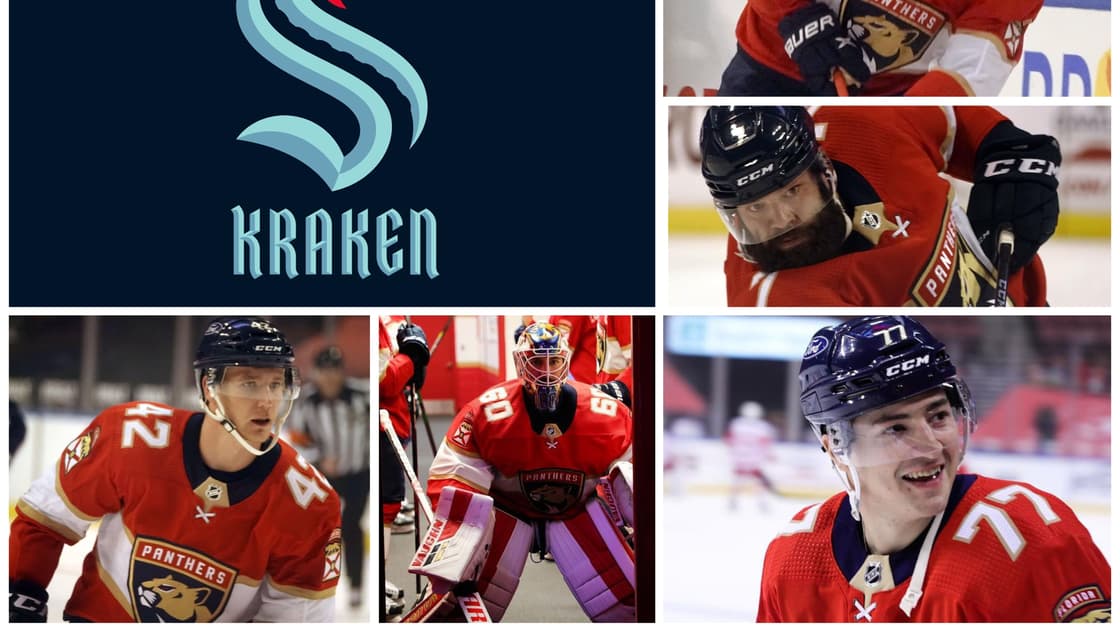
Some of the biggest decisions NHL general managers will make this offseason are which players to protect from the Seattle Kraken and the expansion draft. That includes Florida Panthers GM Bill Zito.
In 2017, the Vegas Golden Knights joined the NHL and the Panthers were one of the teams which got taken in the draft.
The reasoning for what GM Dale Tallon did in 2017 doesn’t really matter much in hindsight.
Vegas got two really good players from the Panthers in Reilly Smith and Jonathan Marchessault as the Panthers decided to protect two defensemen (Alex Petrovic and Mark Pysyk) who ended up falling out of favor with the team and are no longer in Florida.
We’ll get into the Smith/Marchessault deal as we get closer to the Seattle draft — which is now less than a month away.
The Panthers were not the only team to make side deals with Vegas (don’t pick ‘Player A’ and we’ll give you ‘Player B’ plus something extra) and the Knights took advantage of many of them.
Although some called Vegas’ post-draft roster the worst in the NHL, the Knights (as we know now) did just fine with the players they got.
In the franchise’s four seasons, they have yet to miss the playoffs and made the NHL semifinals again this year.
Due to the success of the Knights, some wonder if GMs will be reticent to make side deals with Kraken GM Ron Francis this time around.
But with a flat salary cap for a second consecutive season — and likely to stay the same next year as well — Seattle will be making deals. For sure.
Will the Panthers, again, be one of them?
Perhaps.
Zito has said he has already come to terms with knowing the Panthers will lose a good player to Seattle.
But, in looking to move some contracts he may not want, he may be tempted to swing a trade with the Kraken.
The big dates we are looking forward to are: July 17 when every team releases its protected list before the actual expansion draft four days later on July 21.
The Panthers are going to lose a player (perhaps two) they would rather keep.
Who could it be?
First, the quick and basic rules: Each team is allowed to protect either 11 players (seven forwards, three defensemen and a goalie) or nine (four forwards, four defenseman, goalie).
Zito sounds like he’s going the 7-3-1 route — which is not what Tallon did four years ago as the Panthers wanted to protect four d-men (Pysyk and Petrovic along with Aaron Ekblad and Keith Yandle).
Two of the biggest contracts on the Panthers are players who would have to be protected due to the no-movement clause in their contract.
We are talking, of course, about Sergei Bobrovsky (five years remaining, $10 million cap hit, $58 million in actual money owed) and Yandle (two years, $6.35 million cap hit, $10.5 million owed).
Unless the player agrees to waive their no-movement clause, they have to be protected.
So, until we hear otherwise, we have to assume Yandle and Bobrovsky will not waive their no-movement clauses and would be protected.
In 2017, Roberto Luongo did waive his no-movement clause joking that there was no way the Knights would be crazy enough to take on his contract.
That allowed the Panthers to protect James Reimer instead.
Florida would love to see Yandle waive allowing the team to protect an additional defenseman (Gus Forsling or Radko Gudas).
We’ll see.
So, with the thinking Yandle and Bobrovsky have to be protected — as does Jonathan Huberdeau, although the team would have done that anyway — that leaves eight players remaining.
There are a good number of players the Panthers do not have to protect as they are exempt from the draft due to their time of service.
That group includes goalie Spencer Knight, forwards Owen Tippett, Eetu Luostarinen, Grigori Denisenko, Aleksi Saarela and Aleksi Heponiemi as well as defensemen Chase Priskie and Matt Kiersted.
Unrestricted free agents do not have to be protected unless they have signed with their team prior to the draft.
Because of that, we don’t expect the Panthers — or any other team — to be signing pending free agents before the draft.
In Florida’s case, that includes Chris Driedger, Alex Wennberg and Brandon Montour.
Restricted free agents would have to be protected if a team wants to keep them. For Florida, that list includes Sam Bennett and Anthony Duclair.
Now, if a team wants to keep a free agent they can talk to said player before the draft and potentially work out a deal. When the protected list is released, the Kraken can also start talking to pending free agents.
Any free agents Seattle signs before the draft counts as that selection from said team.
So, in Florida’s case, if Seattle were to sign Driedger (for instance) before the expansion draft, the Panthers would not lose anyone else.
Why would Seattle do this?
For one, it would lock down a player before they can officially hit the open market.
Secondly, a side deal could theoretically be worked out. Say, for instance, the Kraken do want to sign Driedger who will be a highly-coveted free agent when the market opens.
Perhaps they make a deal with Florida that they would sign Driedger before the draft in exchange for something in return from the Panthers. A draft pick (or two) perhaps, maybe a prospect.
This would obviously work out well for the Panthers since, if Bobrovsky is coming back as expected, they have no room for Driedger as much as both sides would like to keep their relationship going.
THE PROTECTED PLAYERS
Again, going with the assumption that Florida will protect the three players (Yandle, Bobrovsky and Huberdeau), let’s look at who else needs to be protected.
These are simply projections.
Forwards (7): Huberdeau, Sasha Barkov, Carter Verhaeghe, Sam Bennett (pending RFA), Patric Hornqvist, Mason Marchment, Anthony Duclair (RFA).
Defensemen (3): Yandle, Ekblad, MacKenzie Weegar.
Goalie (1): Bobrovsky.
Now, let’s look at who would be left unprotected under these projections and why we went with who we did.
THE UNPROTECTED PANTHERS
Forwards: Frank Vatrano, Noel Acciari, Ryan Lomberg, Juho Lammikko.
Defensemen: Anton Stralman, Markus Nutivaara, Radko Gudas, Gus Forsling.
Goalie: Sam Montembeault.
First, the forwards.
In looking at who the Panthers would protect, some of the names are no-brainers.
Others, well, you have to look beyond this coming season.
We decided to protect Marchment based on how the Panthers used him in the second half of last season — and since he got another year added to his contract, they seem to want him to be part of their future.
You could probably flip Marchment with Lomberg or Lammikko, but the Panthers may feel the latter two would be unlikely to be claimed. Marchment, perhaps due to his upside, may be claimed if left out there.
As far as Vatrano and Acciari go, it comes down to contracts.
Both have one year remaining, can become free agents after the coming season. Does Seattle want a utility knife forward like Acciari? Perhaps.
Florida could also decide Duclair would cost more than it wants to pay. If the team doesn’t get the vibe it could re-sign The Duke to a contract it likes, he could be left off and perhaps be claimed.
Vatrano is a different case and, we could see Seattle making him part of its new team.
We all know Vatrano can score (58 goals in the past three seasons) but he is streaky.
The Panthers would pay him $2.6 million next season — and Zito showed last season he can find production at a cheaper price than that.
With money at a premium under the flat cap, every penny counts. Even if Vatrano stays, his stats say he is due for a raise in 2022. The Panthers may end up losing him anyway.
On the defensive side, Stralman is in the last year of his contract and could, possibly, be bought out before the draft even starts. Don’t think so, but perhaps.
The biggest name here is Gudas, a free agent who was one of Zito’s first acquisitions. He has two years left on his contract. He would be a big hit — pun intended — in Seattle.
Forsling had a big impact on the Panthers in his first season here after being pulled off the waiver wire during training camp. The Panthers would love to keep him. If Yandle waives, the bet here is Florida protects Forsling and leaves Gudas out for Seattle to take.
Vegas loaded up on defensemen in its draft and had no problem wheeling them off for more assets.
Seattle could play it a similar way. Florida has a couple defensemen here who could be taken by the Kraken only to be sent elsewhere.
If Gudas is taken, he probably sticks in Seattle and becomes a veteran building block; if Forsling goes, he could be a trade candidate.
As far as goalies go, Montembeault — based on his limited NHL workload over the past two years — is probably sticking around.