
 Alan Greenberg, FHN Sr. Writer
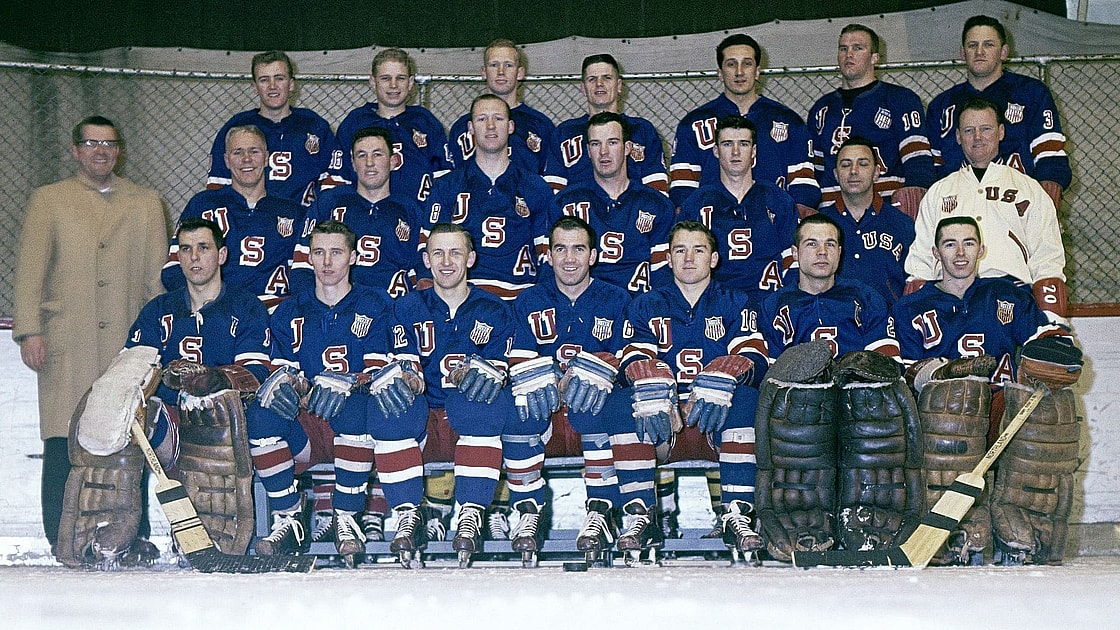
Watching the excellent documentary, Miracle: The Boys of ‘80 on Netflix brought back sweet memories of the amazing victory by the 1980 Team USA Olympic hockey team made up of unknowns during the height of worldwide political turmoil and tension.
For those of us old enough to remember, it was the second coming of the miracle.
Under similar circumstances, the 1960 Olympic Team pulled off an equally spectacular upset, winning the first gold medal for Team USA in hockey.
The similarities are striking.
Both events were on U.S. soil.
Lake Placid, New York, was home of the 1980 Winter Games; Squaw Valley, Calif., hosted the games in 1960.
The powerhouses going into the 1960 and 1980 games were Canada and the Soviet Union.
In each case, Team USA upset Canada and then in the penultimate match, came from behind to upset the heavily-favored Russians.
Both times, it was a group of college and amateur players from the United States against the government-sponsored elite from the USSR.
The 1960 team was coached by Jack Riley Jr., who coached at the United States Military Academy at West Point.
The 1980 coach, Herb Brooks, was not military but his disciplined and abrasive style was military-worthy.
Both played no favorites and openly advocated for the “best team” rather than solely the best players.
Ironically, Brooks was the final cut from the 1960 team.
In 1960, the final match pitted the U.S. against Czechoslovakia; in 1980, it was Finland.
Although the Soviets and Americans were bitter political rivals with an on-ice rivalry that was equally tense, some friendships developed between the players over the years.
In 1960, after defeating the Soviets, the understaffed Americans had to play a rested Czech team the following day.
After two periods they were behind 4-3.
It was then that the Soviet captain, Nikolai Sologubov came into the Americans’ dressing room and suggested they “take some oxygen.”
Several took his advice, and the US scored six unanswered goals in the third period for a 9-4 victory.
Only one player on the 1960 team had success in the NHL: For years, Tom Williams was the only American-born player in the NHL. He played 663 games.
Goalie Jack McCartan was signed by the New York Rangers right after the Olympics, mainly as a publicity gimmick to get fans in the seats to see the mediocre Rangers.
He played four games right after the Olympics and a few the following season before settling into a long and successful minor league career.
His final two professional seasons were spent in the World Hockey Association.
Bill and Roger Christian became very successful manufacturers of Christian Brothers hockey sticks.
Bill Cleary was a long-time hockey coach at Harvard University.
By contrast, 10 players on the 1980 team had formidable NHL careers.
These include defensemen Ken Morrow, Jack O’Callihan, Mike Ramsey, and forwards Dave Christian, Mark Johnson, Neal Broten, Steve Christoff, Mark Pavelich, Rob McClanahan, and Dave Silk.
Others, including goalies Jim Craig and Steve Janaszak, defenseman Bill Baker and forward Rob McClanahan had short NHL careers.
Baker went on to a career as an oral surgeon.
In 1960, there were few opportunities for youngsters to play hockey in the United States.
Even though there were four U.S. teams in the Original Six NHL, the only hockey hotbeds were Minnesota and Massachusetts.
The 1980 demographics were similar, with almost every player hailing from either Minnesota or Massachusetts.
According to hockey-reference.com, today’s NHL includes players from 42 states, including Florida, Arizona, Alabama, and Texas.
This year’s Team USA has players from 13 states, led by Michigan and Minnesota.
In what would have been unheard of in 1960 or 1980, states like New York, Alaska and Arizona are also represented.
And, of course, the Tkachuk Brothers from Missouri by way of Arizona.
Right now, most oddsmakers favor Canada and predict a Canada-USA final.
Sit back and enjoy.
It should be a fun few weeks.
FLORIDA PANTHERS
AT THE OLYMPICS
- United States: Matthew Tkachuk, Seth Jones (injured), Bill Zito (assistant GM), Teddy Richards (equipment manager)
- Canada: Sam Reinhart, Brad Marchand, Sam Bennett
- Finland: Sasha Barkov (injured), Eetu Luostarinen, Niko Mikkola, Anton Lundell, Tuomo Ruutu (assistant coach)
- Sweden: Gus Forsling, Myles Fee (video coach)
- Latvia: Uvis Balinskis, Sandis Vilmanis
- Germany: Jamie Kompon (assistant coach)
2026 WINTER OLYMPICS
MEN’S HOCKEY SCHEDULE
All games streamed on Peacock in the United States and CBC Gem in Canada
- Wednesday — Group B: Slovakia vs Finland, 10:40 a.m. (USA Network); Sweden vs. Italy, 3:10 p.m. (USA)
- Thursday — Group A: Switzerland vs. France, 6:10 a.m. (SN); Czechia vs. Canada, 10:40 a.m. (USA). Group C: Latvia vs. United States, 3:10 p.m. (USA); Germany vs. Denmark, 3:10 p.m. (TSN)
- Friday — Group B: Finland vs. Sweden, 6:10 a.m. (USA); Italy vs. Slovakia, 6:10 a.m. (SN). Group A: France vs. Czechia, 10:40 a.m. (SN, CBC); Canada vs. Switzerland, 3:10 p.m. (CBC)
- Saturday — Group B: Sweden vs Slovakia, 6:10 a.m. (SN); Finland vs. Italy, 10:40 a.m. (USA). Group C: Germany vs. Latvia, 6:10 a.m. (CNBC); USA vs. Denmark, 3:10 p.m. (USA)
- Sunday — Group A: Switzerland vs. Czechia, 6:10 a.m. (CNBC); Canada vs. France, 10:40 a.m. (USA). Group C: Denmark vs. Latvia, 1:10 p.m. (CNBC); USA vs. Germany, 3:10 p.m. (USA)
- Tuesday Feb. 17 — Qualification playoffs: 6:10 a.m. (2); 10:40 a.m.; 3:10 p.m.
- Wednesday, Feb. 18 — Quarterfinals: 6:10 a.m. (USA), 10:40 a.m. (USA), 12:10 p.m. (USA), 3:10 p.m (NBC)
- Friday, Feb. 20 — Semifinals: 10:40 a.m. (USA), 3:10 p.m. (NBC)
- Saturday, Feb. 21 — Bronze medal game: 2:40 p.m. (USA)
- Sunday, Feb. 22 — Gold medal game: 8:10 a.m. (NBC)