
 Colby Guy
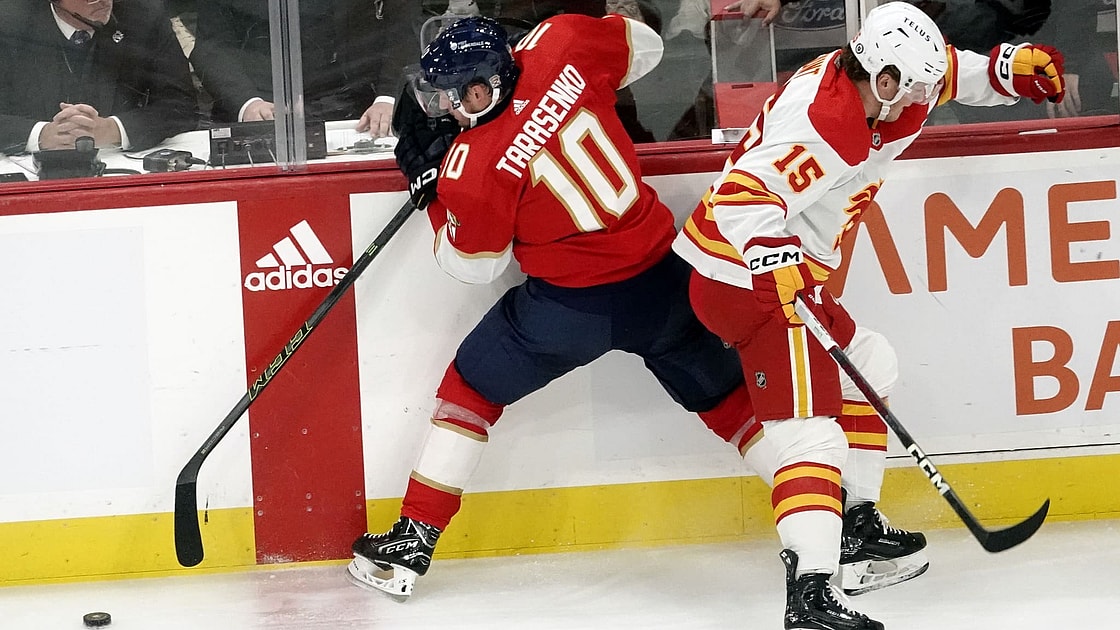
When the Florida Panthers acquired Vladimir Tarasenko two days ahead of the NHL trade deadline, the major storyline was that he would add another wrinkle to the Panthers’ offense.
After all, Tarasenko earned a reputation as one of the NHL’s top snipers after scoring at least 30 goals six times throughout his 13-year NHL career.
And, yes, he has looked as dynamic as ever in his first three games with the Panthers — scoring two goals and three points while generating countless scoring chances — but that has not been the most impressive part of his game thus far.
His play in the defensive zone has been just as good as his offense; Tarasenko has shown he is not afraid to get engaged in the game physically.
It’s exactly the same style of game the Panthers play.
Tarasenko knew he would have to play that way coming in, and was willing to do so because he wanted to come to Florida.
“He can move up and down our lineup a little bit, he can do power play, and he said he is willing to kill penalties, but we won’t start him there,” coach Paul Maurice said ahead of Tarasenko’s debut.
“It does matter that he has a home here, that he wants to be here at this age of his career. We want players that are really going to embrace the opportunity. We have a good team here. He has a Stanley Cup, and he understands what a deep run feels like and the cost of it, so we just felt he fit really well.”
While he is not out there killing penalties yet, Tarasenko has already repeatedly come up with big defensive plays through his first week with Florida.
Late in the team’s 4-3 comeback win over the Dallas Stars, he was out there defending a 6-on-5 in the game’s final minute.
He came up huge, too.
After Sam Reinhart‘s attempt at an empty-net goal went wide, Tarasenko was right where he needed to be, supporting defensemen Brandon Montour and Niko Mikkola with 55.1 seconds to go.
Tarasenko slowed down the rush by getting a small hit on Joe Pavelski, allowing Reinhart and Sasha Barkov to get back into the defensive zone in time to clog up the passing lanes.
When the puck sprung loose after Reinhart went down to block a shot, Tarasenko was there to gain possession of the puck quickly and cleared it while surrounded by four Dallas players.
He got the clear off in time while one Dallas player knocked him over from behind while avoiding an icing call.
The clearing attempt took a deflection off the defender’s stick in front of him.
That sequence came up huge in winning the Panthers the game.
Another big example of his defensive know-how came in the second period of his debut against the Philadelphia Flyers.
After Matthew Tkachuk came out of the penalty box following a 4-on-4, Florida got caught in the defensive zone, with Tarasenko having to play out of position at the center spot.
The natural winger quickly picked up on that and shifted over to man the slot.
He went down, blocked the puck, and deflected it far enough out of play to get off for a line change.
“He is very, very in tune of picking up off other players and playing off position if he needs to,” Maurice said of the play. “Each shift he can come in and play both sides of the ice. That part, he is exceptional in.”
And, of course, the obvious highlights of his game came during his two-goal, three-point performance against the Calgary Flames.
On his first goal, Tarasenko stayed hard on the forecheck and was in position to reach out and snag a Jonathan Huberdeau clearing pass from the wall.
Tarasenko had the all-world hand-eye to quickly retain possession of the puck and get a quick shot off to put the Panthers ahead 23 seconds into the second period.
Tarasenko also flagged down a Mackenzie Weegar stretch pass perfectly near the midway point of the second, reading the bounce off the boards to a tee, then sending a boards pass of his own around a Calgary defender and to Reinhart to start a 2-on-1 rush with him and Barkov.
Barkov blasted home a one-timer a mere four seconds after Tarasenko’s neutral zone play to give the Panthers a 2-1 lead.
However, whether his hockey sense and reading directly lead to goals, he plays a style that wins games.
Tarasenko consistently rushes back on the back check, gets physically engaged, and knows how to read a play quickly to find where he needs to be on both sides of the ice.
“He plays a smart game,” Sergei Bobrovsky told FHN. “He is not searching for just the goals. He plays with the system, he executes the system and at the moment, he can bear down on those moments.”